S2Cool – Sustainable Cooling Research Consortium
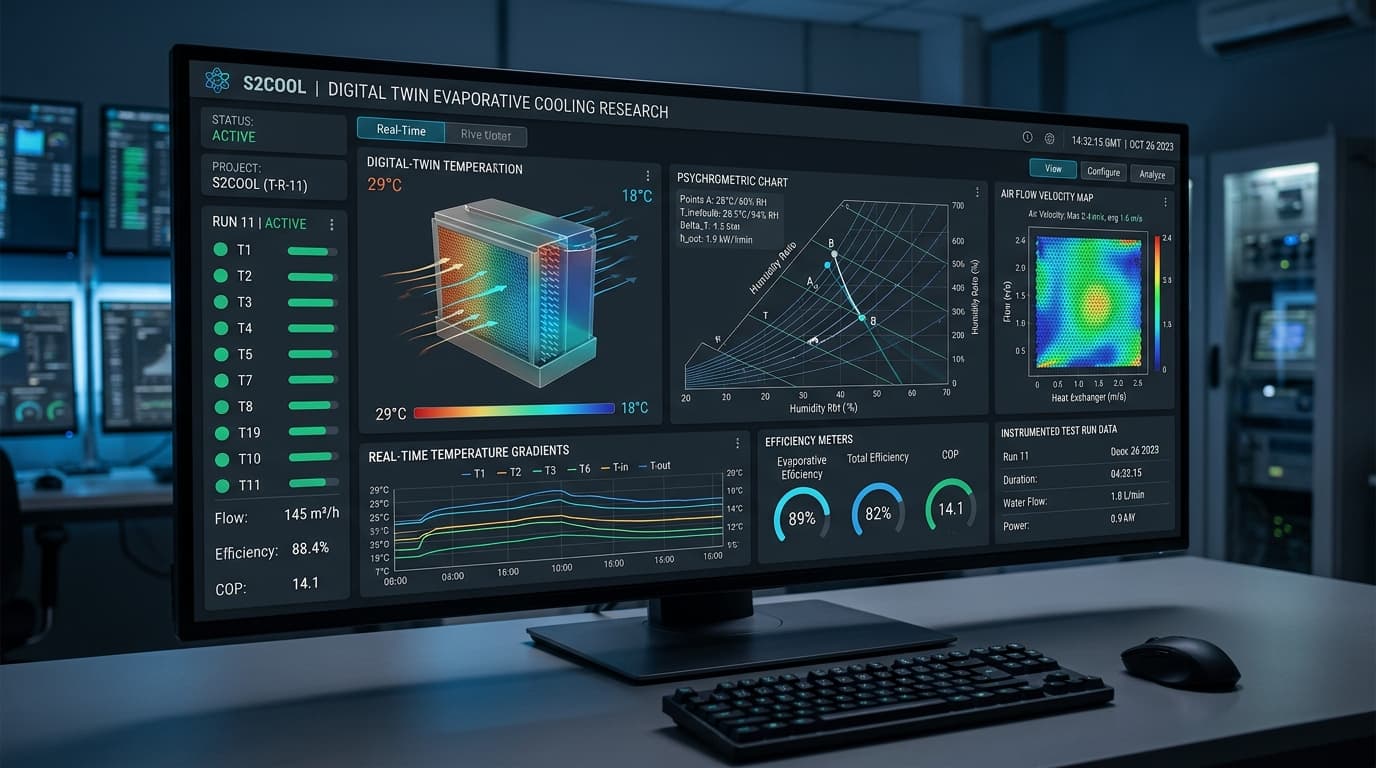
Contributing to a £2.8M UKRI-funded consortium building a digital-twin model of a refrigerant-free evaporative cooling system, combining first-principles equations with ML surrogate models.
Comprehensive Technical Write-Up Available
Explore the peer-reviewed methodology, system architecture diagrams, benchmark comparisons, and academic citations.
Project Overview
S2Cool is a £2.8M UKRI Ayrton Challenge consortium led by Northumbria University, building a digital-twin model of a refrigerant-free evaporative cooling system targeting up to 65% lower cooling energy demand in extreme-heat climates. As part of the NUST SEECS team, supervised by Dr. Moazam Fraz and Dr. Naseer Bajwa, I am transitioning the system model toward a dual-track behavioral model that combines first-principles heat and mass-transfer equations with data-driven ML surrogate models, trained on roughly 66,000 empirical observations from 11 instrumented test runs on the physical prototype. Ridge regression surrogate models are trained per subsystem against sensor data, currently reaching R² ≥ 0.93 and RMSE < 0.5 for supply-temperature and thermal-effectiveness prediction.
Problem It Solves
Conventional cooling in extreme-heat climates relies heavily on energy-intensive vapor-compression refrigeration. Refrigerant-free evaporative cooling offers major energy savings, but predicting and optimizing its performance across configurations is difficult without either expensive physical prototyping for every scenario or a validated model that captures both the underlying physics and real-world sensor behavior.
Tools & Technologies Used
Skills Involved
Challenges
Combining first-principles thermal equations with data-driven ML surrogates without the two producing conflicting predictions was a central challenge, as was extracting reliable signal from noisy sensor data across 11 instrumented test runs on the physical prototype. Achieving high-fidelity, per-subsystem regression performance (R² ≥ 0.93, RMSE < 0.5) required careful feature engineering under real hardware variability rather than clean simulation data.
Learnings
This project gave me hands-on experience in hybrid physics-plus-ML modeling, working within a large, multi-institution international research consortium, and translating raw, noisy sensor data from a physical prototype into reliable, low-error surrogate models suitable for a production digital twin.